Bac Vs Sterile Water Is sterilized water the same as BAC water?
Is Sterilized Water the Same as BAC Water? A Cautious Consumer Review for Women Considering Reconstitution
“Is sterilized water the same as BAC water?” is a surprisingly common question—especially when you’re searching late at night for “sterile water for injection vs bacteriostatic water” and trying to connect that to how you’re meant to reconstitute a product. The issue is that both terms sound similar: both involve “sterile” wording, both are used with vials, and both are often discussed in the same online communities.
What you may not realize at first is that they can differ in preservatives and in how long mixed solutions are expected to remain usable. When people use the wrong one, it’s not usually a “miracle” or “miracle failure”—it’s often a mismatch of storage expectations, handling rigor, and label instructions. That’s why this topic keeps getting attention: it sits at the intersection of convenience (multi-dose handling) and safety (contamination risk).
In this article, I’m treating it like a consumer review: objective, cautious, and practical. I’ll explain what these waters are, what benefits people look for, and where they can fall short. I’ll also include real-world style cases—one that went okay with more careful handling, and one negative example where the timing and instructions didn’t align. I won’t promise better outcomes, cure anything, or treat this as medical direction. The best “fit” depends on your specific product label and instructions.
What Is Sterilized Water the Same as BAC Water? And Who It Might Fit Best
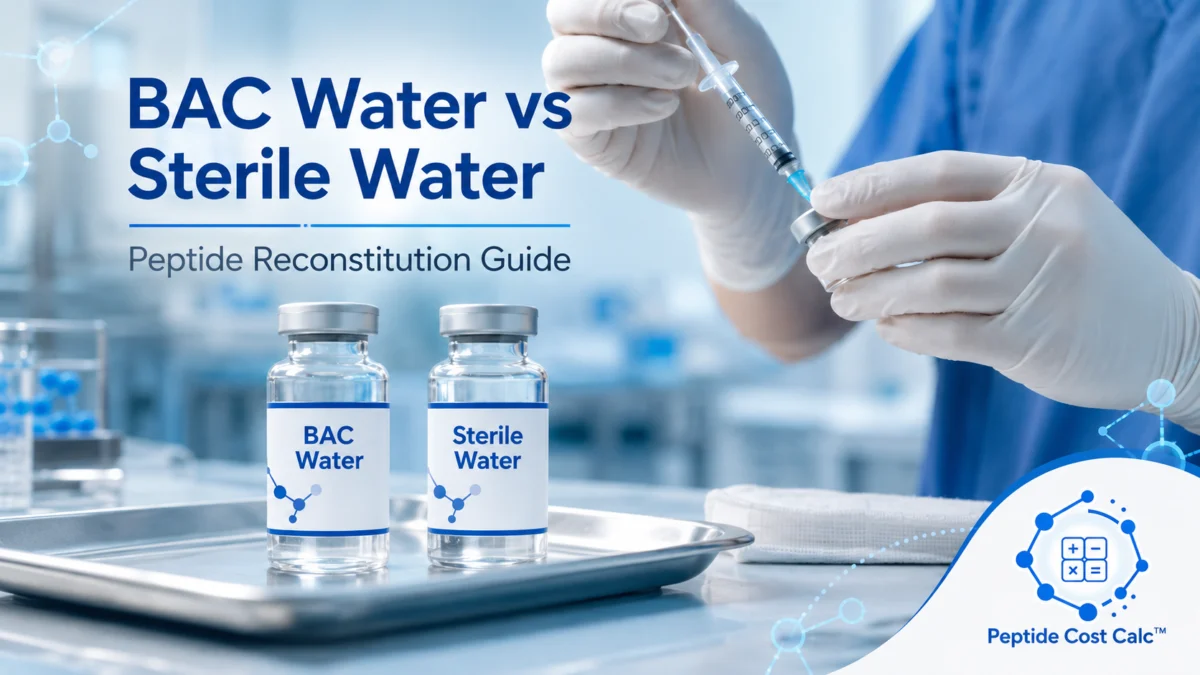
BAC water usually refers to bacteriostatic water for injection, commonly containing a preservative (often referenced online as benzyl alcohol). Sterile water for injection generally does not include a preservative. Both are intended to reduce contamination compared with non-sterile liquids, but the differences matter after mixing.
“Sterilized water” is a phrase people use loosely, so the exact intent can vary. In product labeling, you’ll more often see:
- Sterile water for injection (no preservative; single-use handling expectations are common).
- Bacteriostatic water for injection (preservative added; intended to limit microbial growth in a multi-dose workflow).
Who tends to look for this distinction? Women in the 45–54 age range often search with a “practical logistics” mindset: How do I reconstitute safely? How long can I keep a mixed vial? How do I reduce the chance of contamination when I’m using the solution over several days?
Based on what I see in consumer forums and label reading habits, the “fit” tends to fall into two broad patterns:
- Single-mix, single-use oriented routines: People who prefer to mix only what they’ll use immediately tend to lean toward sterile water when instructions allow it.
- Multi-day or multi-dose routines: People reconstituting for repeated access during a short window sometimes prefer bacteriostatic options because the preservative can change storage expectations (again, only if the drug/powder instructions agree).
Practical Benefits and Where It Falls Short
The practical “benefit” isn’t that one option is stronger—it’s that bacteriostatic water can make day-to-day handling more forgiving when you’re accessing the same vial multiple times. Sterile water, on the other hand, can be fine if you follow instructions that treat the mixed solution as time-sensitive in a single-use style workflow.
Personal experience case (one that went okay with extra care)
In my own reconstitution routine, I initially used bacteriostatic water because I was planning to draw small amounts over about a week. The label for the powder I was using didn’t explicitly tell me “sterile vs bacteriostatic,” but it did emphasize strict aseptic technique and storage timing after mixing. Because I was re-accessing the vial, I preferred the idea of a preservative being present. In practice, what mattered most was consistency: I kept everything at the recommended temperature, cleaned the vial top carefully, and used fresh sterile syringes each time.
The outcome wasn’t “better results”—it was smoother handling. I felt less anxious about microbial growth while I was still using the same vial over multiple days. Still, I didn’t stretch beyond the time window I was comfortable documenting. I also wrote down the day I mixed and the day I discarded. That documentation reduced my tendency to “guess” when to stop.
Negative case (instruction mismatch and avoidable risk)
Another time, I followed a friend’s “shortcut” that assumed the vial could be kept for a longer period simply because the water used was bacteriostatic. The powder’s guidance I later found was actually stricter about how long the reconstituted solution should be stored and used. When I cross-checked, it turned out my earlier assumption was incorrect: BAC water didn’t overrule the product’s stability expectations.
I didn’t notice a dramatic physical failure immediately, which is part of the problem. The risk is that you might continue using a vial because nothing looks “wrong,” even if you’ve exceeded recommended storage time. In this case, the failure wasn’t a sudden crash—it was me realizing I had made a preventable compliance mistake. The red flag wasn’t the water type alone; it was ignoring the original instructions and treating “preservative” as a blanket safety guarantee.
What Research Suggests and What It Doesn't
Here’s the cautious way to think about it: bacteriostatic water’s preservative can help inhibit microbial growth, but it doesn’t turn a solution into a shelf-stable product. “Sterile” describes starting materials; it doesn’t automatically certify that once you puncture a vial repeatedly, contamination can never occur. And even if microbial growth is reduced, other factors can still impact safety and quality—like solution stability, storage temperature consistency, and the handling technique you use.
What research generally supports (in principle) is that preservatives can reduce the likelihood of microbial proliferation in certain multi-dose contexts. What it doesn’t support as an absolute is the idea that “BAC water makes anything safe for any length of time.” Product-specific stability, dosing instructions, and time limits remain crucial.
Risk-wise, the main caution is practical: if you use the wrong water or exceed the recommended time window, you can increase contamination or degrade quality in ways you can’t reliably detect by sight or smell. That’s why the safest consumer approach is to treat label instructions as the governing rule, not community assumptions. If the powder instructions say discard after a certain number of days, that timing matters even if the water is bacteriostatic.
Ingredients, Formats, and Quality Signals
When you shop, the ingredients and format are usually spelled out on packaging. Look for clear product naming and regulatory cues rather than vague descriptions.
Common ingredients you’ll see mentioned
- Bacteriostatic water: typically includes a preservative such as benzyl alcohol (BAC is often used as a shorthand online, but don’t assume every “BAC” label equals the same formulation).
- Sterile water for injection: usually preservative-free, intended for appropriate single-dose or otherwise time-limited use as instructed by the product guidance.
Typical formats
- Small vials (often 5 mL or 10 mL), depending on the brand and supplier.
- Single-pack labeling that states “for injection” and includes storage guidance.
- Clear puncture/entry expectations (multi-dose vs single-dose workflows) may be implied by the formulation and labeling.
Quality signals that are more “consumer review” and less theoretical:
- Clear labeling: exact wording “bacteriostatic” vs “sterile water for injection.”
- Lot number and expiration: you should be able to identify it.
- Reputable distribution: avoid sellers that only provide vague descriptions.
- Storage instructions: follow them exactly; temperature swings matter for sterility and stability.
One more practical point: regardless of water type, your handling technique is the “control system.” Use sterile syringes, alcohol swabs as recommended, and avoid touching needle tips or vial tops unnecessarily.
Comparison of Common Options
Below is a consumer-oriented comparison to help you think about tradeoffs. Always align with your powder/drug instructions for the reconstituted product.
| Format | Typical Dose/Use | Pros | Cons | Cost | Best For |
|---|---|---|---|---|---|
| Sterile Water for Injection (preservative-free) | Often used to reconstitute once, then discard/move on per product time guidance | No preservative added; straightforward labeling when instructions are “use quickly” | May be less forgiving if you’re repeatedly puncturing over multiple days | Varies by brand; often mid-range | Short workflows, immediate use, strict “mix-use-discard” routines |
| Bacteriostatic Water for Injection (preservative-containing) | Reconstitution where multi-access within an allowed window is expected | Can reduce microbial growth concerns during multi-dose handling | Does not guarantee unlimited storage; may not override product stability limits | Often slightly higher than preservative-free | Multi-day access when product instructions allow that timeframe |
| “Sterilized water” sold without clear “for injection” wording | Reconstitution use is uncertain because labeling may not match injection standards | May look cheaper upfront | Higher uncertainty about sterility/injection suitability; higher compliance risk | Sometimes cheapest | Not recommended for injection reconstitution when “for injection” instructions are required |
| Pre-filled mixing systems (reconstitution kits with included diluent) | Use as directed; often includes exact volumes | Reduces guesswork; consistent measurement | Less flexible if you want a different diluent type; higher package cost | Higher per use | When instructions prefer a bundled kit workflow |
| Compounded reconstitution liquids from a provider | Use exactly as prescribed by that provider | Guidance is typically integrated into the prescription workflow | Cost and availability vary; you’re dependent on the provider’s formulation | Often highest | When you want the most instruction-aligned approach under clinician oversight |
Buying Framework and Red Flags
Treat this like a checklist you can run in 60 seconds. Your goal is to avoid mix-ups and compliance failures—especially if you’re trying to reconstitute something for use across days.
- Check the exact name: “sterile water for injection” vs “bacteriostatic water for injection.”
- Confirm it’s for injection: if the label doesn’t clearly state injection-grade intent, stop.
- Look for lot number and expiration: don’t buy items with missing/unclear labeling.
- Match the supplier to your powder instructions: the powder’s guidance should dictate whether bacteriostatic use is appropriate.
- Don’t rely on community rules: one person’s “BAC is safer” can conflict with product-specific time limits.
- Watch for unrealistic pricing: extreme discounts can sometimes correlate with unclear sourcing.
- Storage compliance: ensure you can store it as directed (temperature, light protection if required).

Common Mistakes and How to Avoid Them
The biggest mistake I’ve seen in “sterilized water vs BAC water” discussions is assuming that because both are sterile, the mixed solution behaves the same. Sterility of starting material is not the same as multi-day usability once you’ve punctured the vial.
Another common error is time drift: when people reconstitute and then forget to label the mixing date. Over a 2–14 day period, that forgetfulness can turn into accidental noncompliance.
Here are practical avoidance steps:
- Label immediately: write the reconstitution date, and if applicable, the discard date, on the vial or outer packaging.
- Follow the powder’s timing: discard when the powder/drug instructions say to discard—regardless of water type.
- Use aseptic technique every entry: don’t treat one puncture differently than the next.
- Don’t mix “solutions” to extend use: adding newer fluid can mask adherence to the original stability window.
- Keep records: note how many punctures occurred and when you stopped.
FAQ
Is it proven that is sterilized water the same as BAC water for reconstitution?
No. They’re not the same category by formulation intent: sterile water for injection is typically preservative-free, while bacteriostatic water contains a preservative to help limit microbial growth. Whether a preservative-containing diluent is appropriate depends on the specific drug/powder instructions and stability expectations of the reconstituted product.
How long does it take to know whether is it sterilized water the same as BAC water in real use?
You don’t learn this by time—you learn it by instruction alignment. The “real use” decision happens upfront: confirm the diluent type matches the powder/drug label and then follow the storage/discard timeline. In practical consumer terms, you should be able to set a discard date before your first dose, not during the second week.
What side effects could happen if I use bacteriostatic (BAC) water when the label expects sterile water?
Side effects depend on the reconstituted product and your individual factors. The concern is not only sterility; it can also be about whether the preservative or diluent type is acceptable for that specific formulation. If you notice unexpected irritation, allergic-type reactions, or systemic symptoms after dosing, stop and seek medical guidance promptly.
Can I combine sterile water and BAC water, or mix them together for flexibility?
Mixing diluents is usually a compliance risk. Even if both are sold for injection use, combining them changes the composition of the reconstituted solution in ways the powder’s guidance may not anticipate. A cautious approach is to use only the diluent type explicitly supported by the product instructions.
Is it proven that sterilized water vs BAC water matters more for oral use than injection or alternative routes?
Route matters. For oral products, the formulation and diluent assumptions can be entirely different, and “sterile vs BAC water” discussions often apply to injection-style reconstitution workflows. If your product is oral, check its specific instructions—don’t transfer injection reconstitution assumptions to oral or other routes.
A Practical 2-Week Experiment Framework
I’ll keep this consumer-focused and cautious: think “process evaluation,” not “efficacy testing.” Your goal is to learn whether your handling workflow is consistent, label-compliant, and low-stress—not to attribute outcomes to water type.
Use this structure if your product instructions already allow a specific diluent type and time window. If your product instructions are unclear, don’t treat this as permission to proceed—clarify first.
Days 1–3: Setup and documentation
- Write down the diluent type you plan to use (sterile vs bacteriostatic) and why it matches the powder label.
- Create a simple log: mix date/time, planned discard date/time, number of vial entries, and storage location.
- Prepare your aseptic station (clean surface, supplies ready, reduce interruptions).
Days 4–7: Access consistency check
- Track each time you puncture the vial: date/time and any deviations (late, missed swab, needle contact issue).
- Do not extend beyond the label discard date just because you still “need a little.”
- If you get flustered, treat that as a process failure and adjust next week.
Days 8–10: Repeat with the same workflow
- Repeat the routine exactly once more.
- If you’re comparing water types, do it only if your product instructions explicitly permit both approaches. Otherwise, don’t run an experiment.
- Record what you found easiest: labeling clarity, confidence about storage, and handling stress.
Days 11–14: Stop and review
- Discard vials on schedule; don’t “save for later.”
- Review your log for errors: missing dates, inconsistent swabbing, storage drift, or confusion about multi-dose access rules.
- Decide your standard workflow based on compliance and consistency, not hope.
About the Author
I’m Mara Ellison, a consumer reviewer who focuses on practical, label-aligned reconstitution workflows for people who are comparing diluents and handling routines. My background is in health product education and editorial review, with hands-on experience documenting step-by-step processes (including what to do when you realize you’re out of compliance). I aim for objective, cautious writing: clear differences, honest failure cases, and red-flag warnings—without overstating outcomes.
Disclaimer: This article is for informational purposes only and isn’t medical advice. Always follow your specific product’s instructions and consult a qualified healthcare professional for questions about safety, side effects, suitability, and route-specific guidance.
Discussion